Saturday, July 29, 2006
Only by going
I could glance through dozens and dozens of sites about the wonders of Macedonia and about the catastrophic earthquake of Skopje in 1963 but that would never live up to the experience of hearing from my friend's parents how their house shook for over twenty seconds and how they slept weeks in a tent. In the same way I had read several articles about the changing labour market of Bulgaria but it could never compete with our taxi driver in Sofia who turned to us and said:"I am 53 years old. I am an intelligent taxi driver with three degrees. There is nothing for me in this country."
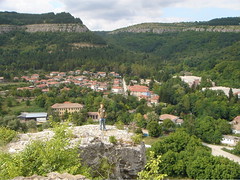
It is really difficult to define what I thought of these two countries before travelling. I could maybe mention terms such as conflict, war, EU accession and yoghurt. After meeting people and travelling across the countries I would say untouched nature, fresh salads and garlic, glorious history, religion and kind and humble people. I am not claiming that I know what these countries are about but I know much more about the challenges of Macedonia to create a common identity among the Macedonians and the Albanians. I was also amazed by the way urbanisation can be seen in these countries: the untouched mountains and forests and the grannies of the small villages collides with the chaotic traffic and with the lack of urban planning vision of the capitals. I guess my two souvernirs can be used well as evidence of my way of seeing these countries: two photographs of smiling grannies and a bottle of mastika (Macedonian ouzo) donated by my friend's father.
I want to go back. At the same time I realise clearly how fortunate I am to be able to travel freely and visit friends all across the continent.
Clever quote of the day (which is in no way connected but I still need to share it):
"Another retrogressive aspect of the modesty movement is its disconcerting message that women are responsible for men's behaviour. The notion of dressing modestly comes at least partly from the idea that men can't control themselves; by telling women that they have to dress a certain way to quell men's desires, modesty advocates are sending a clear message that the onus is on us to control men's sexual - and possibly violent - actions."
- Jessica Valenti:"Chastity is chic" in todays Guardian.
Could not agree with her more.
Monday, July 24, 2006
Things that make you mmmmm
1. Swimming in lakes - during this holiday both in Finland and Macedonia.
2. Shopska salad - cucumber, tomato, onion, olives, white cheese (sort of feta), vinegar, olive oil. It rocks when the ingredients are good.
3. One month holiday - 2 weeks in never enough for forgetting work.
4. Good friends - a friend of mine proved once again that a bus trip of five and a half hours is a blast in a good company.
5. Istanbul - I cannot wait to get there in a month. In the mean time I am preparing myself by reading Orhan Pamuk's short story collection Istanbul.
More later. Now time for food.
Friday, July 14, 2006
Being wrong is at times a nice feeling
The biggest reason for joy was Bush's and Merkel's press conference yesterday. The leaders criticised Russia with clear words. Bush advised Putin to leave the scaremongering and said that it is Russia's own benefit that they would share the same values - such as freedom of the press - as the United States and Germany. Merkel said that a wide range of opinions supports the stability of a country. Although I know that the US is not the number 1 country in the world when it comes to press freedom, I would still congratulate Bush for his courage this time.
The other piece of news that made me extremely happy were the latest comments of my former professor, Commissioner Olli Rehn. I have always seen Rehn as a man with clear values and courage to act and therefore being highly approachable and also excellent to deal with delicate issues such as the EU enlargement. Rehn is one of the best lecturers I had during my studies. He was also very attentive and made an impression when he asked last year in a conference how my thesis was proceeding and even remembered the subject. This was when he was already a member of the European Commission.
In the article Rehn commented on the future of the enlargement negotiations. In addition to many brilliant remarks, he said one of the wisest sentences I have heard from a European politician for a while. At the same time when he is extremely strict on the membership criteria, he is still a firm believer on the idea of enlargement. Rehn said:"There is no point in drawing the border of the European Union with a wide marker when we just got rid of the Iron Curtain."
Speaking of enlargement, I will be travelling during the next two weeks to two of the candidate countries. I am having my holidays with a dear Finnish friend of mine in Bulgaria and Macedonia. I must admit that I have no idea what to expect.
Thursday, July 13, 2006
Don't Speak
After that I read from the Finnish daily Helsingin Sanomat that Putin has said that he is not going to listen to lecturing about democracy in the upcoming G8 Summit in Russia. He has blaimed the critics for colonialism. "If you look at newspapers hundred years back you can see how at that time colonial powers justified their politics in Africa and Asia. They talked about their civilising role, the duty of the white man. If you now change the word civilisation to democracy, you can find the same logic and and you are able to read the same things from newspapers. There are differences between countries and forgetting that is dangerous", Putin said.
Although he was not speaking about this concrete case, I find it being extreme cowardism if the EU - boasting normally with its "European values of human rights, freedom of speech and tolerance" - is not going to say a word. But the most awful thing is that I am not too optimistic.
Tuesday, July 11, 2006
It is not that difficult
As I got on the bus I opened my laptop to write one short work text. I decided to play one of my favourite songs in life, Baz Luhrmann’s Everybody’s Free (To Wear Sunscreen). I listen to this song at least twice a month because its instructions for life just rock. Somehow, after being on holiday for a week and meeting my family and all, the following part of the lyrics totally hit me. Yes, this is what it is all about.
”Get to know your parents. You never know when they will be gone for good. Be nice to your siblings. They are the best link to your past and most likely to stick with you in the future. Understand that friends come and go. But with the precious few, you should hold on. Work hard to bridge the gaps in geography and lifestyle. Cos the older you get, the more you need the people who knew you when you were young.”
Monday, July 10, 2006
Doing a good job
F:"So how was the presidency in Austria?"
A:"Well, it was really seen as part of the cabinet promoting their own thing. And because the cabinet is not very popular, the presidency was more like what-ever."
F:"Oh, for us it is seen as a national project. Everyone is SOO proud. It's like back to the good old times of the nation state."
And the point was proven in two minutes. A drunken guy started promoting the country to our group loudly.
"Where are you people from? Welcome to Finland!"
Tuesday, July 04, 2006
Let me represent you
The venue – Rantasipi hotel in the middle of a forest - was brilliant. I find it a bold and correct move to organise a meeting such as this (bringing together youth organisations, policy makers and administrators) far away from the centre of Helsinki. This decision can be praised for two reasons:
1. A small city such as Hyvinkää is so proud of having an EU meeting. The locals were totally amazed by the exotic foreigners in the bars.
2. People stick together and do not get separated.
There was a lot of frustration in the air during the meeting. Several youth representatives felt that they were being patronised and that the goals of the meeting were not clear. At the same time some of the people coming from local and national level experienced a certain level of resentment towards the people from the European youth lobby organisations and with their carefully thought agendas. I saw some youth delegates raising their eyebrows when a youth lobbyist was all excited about structured dialogue with the Commission. This setting posed the risk that all youth participants would have left the meeting with some frustration – although for completely opposite reasons.
The question of youth representation is always problematic. At the same time I recognise the need for European youth platforms but I also find it artificial to think that the chair of a European platform organisation could play the role of The Voice Of European Youth. I am not saying that he/she would be doing this. I think it is actually something that several politicians and administrators would often fancy, i.e. having one clear partner to talk to. When they get contradictory messages from the youth delegates, it gets tricky.
In the closing session we discussed the conclusions of this meeting. The topic of the meeting was active citizenships, stressing the need to recognise also the social, cultural and economic citizenships. Due to the composition of youth in the meeting the political citizenship was highly overemphasised. There was a surprisingly strong lobby for more funding for European platforms and action proposals for increasing the voting rates. This is not to blame the people in the meeting but it is only an example of the complexity of listening to youth. Everyone seemed to recognise the need to give more visibility to the idea of several citizenships but when we got into discussion on the actions, more than 90 % of the proposals were about voting and increasing memberships in traditional youth organisations.
One of the key problems in youth representation is the relationship between power and responsibility. A lot of the people in the meeting were calling for more power but at the same time there was no accountability considering the proposals put forward. As one of the facilitators pointed out, there were a lot of complaints by youth representatives that they were not being heard and it was usually the loudest people of the meeting (who got several amendments through) putting this complaint across.
Tricky, ain't it?
Thursday, June 29, 2006
Timber?
Ayaan Hirsi Ali is Dutch (again). Her lawyer proved that the name Ali is in her family and therefore she was not lying because the Somali habit of using last names differs from the Dutch concept of names. In her letter attached to the minister´s letter to the parliament Ayaan Hirsi Ali apologised for misleading the minister.
If Verdonk gets a vote of no confidence, that would probably mean that the Dutch government is dissolved. As pointed out clearly by the leader of the Social Democrats yesterday, this is not only about Verdonk, it is the Prime Minister who has to carry a substantial amount of the responsibility of this incident.
The big discussion is now about the implications of this turnaround when it comes to the other asylum seeker decisions.
I have been learning a lot of Dutch words lately. Here are a few:
Turkije (Turkey), partij (party), slagroom (whipped cream), vlak (area), kunstenaar (artist), keuze/kiezen (choice, choose), talentontwikkeling (talent development), te hulpen (to help), twijfel (doubt), onderwerp (enterprise), bedoeling (meaning), achtergrond (background), samenleving (society).
Sunday, June 25, 2006
Beauty of Friesland
The reason for this praise is the woman in the picture: Nynke Laverman. She is just absolutely superb. I saw her live a few months back and have been talking about her ever since. But now I bought her new album and have been listening to it on repeat for days.
She is a fascinating combination of things: beautiful and charismatic woman (presumably) with a classical background, singing fado music in Frisian. Frisian is a regional language of Friesland. It is in many ways close to Dutch but not understandable for most Dutch people. Frisian fits well for fado as it lacks the spitting-inwards sounds of Dutch.
I think I am going to market Nynke Laverman when I go to Finland for summer holidays.
p.s. I am one of those people who have constantly a song playing in their head. For days it has been Tom Jones' Breakin' Up Is Hard To Do.
p.p.s. I have totally neglected my project to learn Dutch. The new words I have learned during the last weeks are:
difference between maken (to make) and doen (to do); tussen (between); elkaar (together); difference between mijn vriend (my partner) and vriend van mij (a friend of mine); als (as, when, like, if); waar kom je vandaan (where do you come from); simpel (stupid)
Friday, June 23, 2006
Experiencing diversity
Another example of experiencing diversity: my employer has a new website.
Thursday, June 22, 2006
No Fear
Sorry for the delay of putting it here.
An interesting thing happened in the Dutch translation. My friend (who happened to be a woman) who is mentioned in the article transformed into my girlfriend during the editing. It´s like on MTV: Pimp My Friend.
---
No Fear
My friend falls into silence as we sit down in the tram. She arrived from Finland an hour earlier. As we pass the Dam square she turns to me.
"People look so….how should I put it…different here." I recognise the reaction from sixteen months back. The move from Helsinki - a city with only 2,1 % of immigrants - to the centre of Amsterdam was a gigantic leap towards a multicultural society.
My friend and I are not alone with this amazement. Many of us experience confusion as the number of people who stand out from the crowd in European cities continues to grow. We are in constant negotiation as we position ourselves according to differences in ethnicity, religion and clothing to name a few. Confusion is experienced both among the majority and the minorities.
Without proper conciliation this transformation leads into dangerous political implications. An increasing number of Europeans feel that the growing diversity questions their lifestyles. A fear of falling changes multiculturalism from happy hugs in Benetton ads into a threat. As a result, more and more people volunteer to trade liberal goals of personal responsibility for tighter government protection. Populist political rhetoric speeds this up by encouraging us to reach for the eject button. “Please make this stop.”
I believe that this development threatens the essential idea of a metropolis. The biggest risk to European cities is posed by control, not immigration. It goes without saying that a spontaneous and slightly disorganised city is a challenging atmosphere to live in. I would still claim that in the end it is better for us all. The public sphere should not be a domain where actions need the approval of a security guard - even if this liberalism means that we need to accept occasional disruption and turmoil.
This is not a call for chaos but for a modern city that allows several ways of being local. I prefer a town where a bar terrace takes over the street on a warm evening or where I may bump into a friend at the market. I like seeing bikes locked or stickers glued to peculiar places. I wish to live in a city where I may need to change my cycling route because of a demonstration and where the bus driver is allowed to wear a headscarf or a piercing. Amsterdam is still flexible enough for a significant amount of personal liberation.
The more of us feel that our lifestyles are welcomed; the stronger is our will to take care of the public sphere. The current lobby for uniformity and stability works against the very idea of personal freedom and playfulness.
Our biggest challenge is creating public domains that are free from representational minority and majority roles. Immigration is an easy scapegoat when most problems are really due to socio-economic differences. It is extremely easy but irresponsible to point the finger at the people who have the most adjusting to do. We can do better than that.
Tommi Laitio
Wednesday, June 21, 2006
In Europe
I have witnessed this a few times during the last weeks. I attended lately a workshop on social diversity in cities and especially on Amsterdam. The sense of despair was very evident. But if you would have phrased things differently, Amsterdam would have offered a lot of reason for optimism. The murder of Theo van Gogh has not only polarised Dutch politics but it has created a sense of urgency to seek for solutions. Same could be said about the NO referenda. Even though they slowed the integration, there is now a lot more discussion on Europe.
I attended yesterday in Vienna a lecture of Professor Tony Judt. He is Professor of European Studies and History at New York University and just published a well-received book on Europe called Postwar. The topic of his lecture was Europe in the American Mirror.
Judt’s main argument was that the greatest difference between the US and Europe is the 20th century experience. The European social model was built by old men born in the late 1800s with the goal to prevent a new war. According to Judt’s the lack of this war experience and massive casualties makes it impossible for Americans to understand that the European social model cannot be evaluated only on economic terms.
He also argued strongly against the common conception of globalisation. As Judt brilliantly pointed out, the shared assumptions on the future in 1900 were the following:
1. War in Europe is not possible both on economic and political terms. A democratic society would not tolerate such casualties.
2. The following century will be the century of Germany in Europe.
3. Globalisation (then industrialism and booming telecommunication) is transforming our lifestyles and makes borders near to meaningless.
Judt asked – rightly so – whether there are huge differences compared to the current views on future.
I started thinking after the lecture what is the generation experience of my peers and me. The European project is less and less founded on the notion of peace. I know very well that there has been a war in our continent in 1990s but still I cannot grasp on the notion of peace. It is extremely abstract to me.
I would like to be optimistic on the ways the ERASMUS exchange programme and grown freedom of mobility have made us see further, across the borders of nation states. I would really like to believe that at least part of the generation have a strong belief in a new way of living together.
For me the most eye-opening experience has been working with people from the Balkans, Romania, Ukraine, Moldova and Turkey. After witnessing the difficulties on our external borders I cannot see any sustainable arguments against further enlargement. Tony Judt said brilliantly that in order to engage into the American Dream fully one needs to leave the current life behind and move to the US where as the European Dream is something that comes to you. This is something to be proud of. I often find it remarkable how so many Finns have already forgotten what it felt like to join ”Europe” in 1995.
p.s. On my way home I completed Philip Roth’s latest novel called Everyman. The author voted as the greatest American writer alive by The New York Times reveals the fear of getting old and sick. The main character who has always been healthy and vigorous is suddenly in a situation where his body tells him clearly that it is time slow down. Roth reminds me in many ways of Ian McEwan in his straight-forward and detailed writing. I read the book at the right time – in the middle of the busiest month this year, on planes and hotel rooms.
Friday, June 16, 2006
Back and forth
It has been a brilliant week or so. I was in Lisbon last weekend for work. That city is just amazing. Friday night in the district of Bairro Alto means loads and loads of people wandering from a bar to another with their drinks, chatting to strangers on the streets and so forth. And five days in Lisbon is like going to the gym. My colleague and I had the feeling that we were going uphill all the time.
The city is quite amazing. The food is fabulous and relatively inexpensive, men's clothing is not designed for giants (like here in Holland), caipirinhas cost 4 euros, the sun was shining constantly and my colleague speaks Portuguese. What can I say but even with the slight food poisoning it was a brilliant visit. And a female colleague said that she appreciated greatly the fact that men let her sit in peace in cafes. Lisbon is a bit messy but that only adds up to the charm. A city cannot be too bad if even the graffitis are quotes from Fernando Pessoa.
On Wednesday started an event of the British Council called the Network Effect but I think I will write on that issue later. My only comment is that as was said during the last session, a functioning network is not only about bringing the people together. It is also about doing something together.
Thursday, June 08, 2006
On my way
It has been quite a week. Last weekend we did a workshop with asylum seeker youngsters here in Amsterdam. These youngsters have gone through so much that I think I can never understand. Many of them have been living in the asylum seeker centres for six years or so. They are being moved around all the time. And still I met a group of polite, funny and smart 16-21-year-old guys and young women. Their videos are already online. I like many of them but my favourites are the videos by Louis&Vino, Rauf and Hossein.
I really like working with youngsters. The workshop reconfirmed my belief that all talk about passive youth or so is just complete bull.
Tomorrow morning we are off to Lisbon. That should be fab. We have a meeting there on Monday but we decided to use the weekend for seeing some contemporary performances and hanging out.
Tip for all Dutch and Finnish readers: Finnish weekly Suomen Kuvalehti will publish an article of mine tomorrow and the Dutch daily de Volkskrant on Saturday.
Thursday, June 01, 2006
Big day, bad day
Three piece of news from today´s stream:
1. Reason for joy
It has been 100 years from the day when the Finnish parliament was decided to be formed as a one-house system and with voting rights for all. This included, as the first country in Europe, women´s voting rights. New Zealand and Australia gave women the right to vote before Finland but in New Zealand women did not have the right to stand as candidates and in Australia no women were elected. In Finland 19 women (nearly 10 %) were elected to the first Parliament. The Finnish daily Helsingin Sanomat has produced a beautiful webortage on the subject.
2. Reason for hope and optimism
Helsinki City Council decided yesterday to start a shelter for homeless people in the best area of Helsinki even if most of the schools, entrepeneurs and citizen groups were against it. I would like to congratulate the people voting in favour for their courage. Few comments from the debate yesterday.
"Marginalised people commit marginalised acts that are not things children should see." - Heikki Lampela, Conservatives
"You can´t raise children in a way that they would not see less privileged people." - Anni Sinnemäki, The Green Party
3. Reason for worry
A Russian online newspaper www.cursiv.ru was closed by its Internet service provider on 22 May, three days after prosecutors started investigating its editor, Vladimir Rakhmankov, on charges of “insulting a representative of the state” under article 319 of the criminal code in an article headlined, “Putin, Russia’s phallic symbol". Read full comment from Reporters Without Borders.
Dutch words of the day:
- spullen (stuff, equipment)
- derdelijk (thirdly)
- overnachten (stay over)
Wednesday, May 31, 2006
You don't want to be a criminal, do you?
We have a new time management system on our computers at work. It is slightly annoying but I guess it is a good reminder in the end that you should stare at the screen 7,5 hours continuously. (Oops, already posted this when I noticed that the previous sentence is missing a crucial word. There should be a NOT between should and stare. Sort of a Freudian, is it?)
The best part of the programme is the tone of the messages. And I thought it was uniquely Nordic that The System is in control. My favourite box of this programme is. "You have been working now for two hours without a break. You are about to break the Dutch labour legislation." Talk about attitude.
Dutch words of the day:
- herinnering (reminder)
- het meest beslissende (the most decisive)
- communiceren (to communicate)
- veilig (safe, secure)
And I am still not sure how you spell the word "write" in Dutch....
Tuesday, May 30, 2006
Joining the team
Well, after some pondering I came to the conclusion that even if I would be staying for only a short time, it does not hurt to integrate with the society. The expat bubble feels a bit small after some time.
I took a step to this direction a while ago by subscribing to a Dutch newspaper. It has helped me to realise who are people like Minister Donner, John de Mol, Femke Halsema, Hasna El-Maroudi, Ahmed Aboutaleb, Laetitia Griffith and Marco Borsato. As a political scientist this has made me feel less ignorant.
My second step has been speaking Dutch more often. I have written several text messages and emails in Dutch and decided to speak only Dutch with two of my colleagues. It is slow and at times frustrating but I am sure that in the end it is the right decision. I realised that it is really a silly attitude to think that Dutch would not be a useful language to learn. All languages are useful.
I decided to document my learning process by listing in my blog new Dutch words that I have learned. Yesterday's and today's words are (translations are not exact):
lullen - babble
gek - strange, unusual
lief - sweet
huilen - cry
afstand - distance
pot - lesbian, dyke (offensive phrase)
Sunday, May 28, 2006
Confession of a killer
I had dinner in a superb restaurant in Brussels called La Manufacture. Beautiful interior, top of the class service and remarkable food on decent prices. I started with the best prawns I have had in years. They were served with vanilla marinated tomatoes. Weird but nice.
I ordered a fillet of gilthead as main course. When the waiter brought the main courses, she put a plate with chicken in front of me. For a reason difficult to explain I did not react. I checked with my dinner date: no, this is definitely not gilthead.
Well, I outsourced my principles, hoped that this chicken had a happy life and enjoyed every bite. The chicken was moist and slightly crispy served with a rhubarb compote and a cake with olives. It was absolutely divine. And I was even happier when I saw the gilthead dish I ordered being served to the next table and it looked like the fish was slaughtered on top of mashed potatoes.
Very delightful act towards my principles.
p.s. My last column for Ellit was published. It is on where people should take photos and where not. I must admit that I feel a bit sad that it ends.
Tuesday, May 23, 2006
Reason to worry?
- The Netherlands is the only Western European country with more people moving out than in.
- in 2005 121.000 persons left the country. This is the highest figure ever. The number of people moving in (immigrants) was 92.000.
- During the first quarter of 2006 5.000 people more than last year decided to leave the country.
- Emigration rose most among the over 55-year-olds. A majority of the emigrants are 20-30-year-olds.
That's something to think about. In the article the prices of housing are mentioned as one reason.
Sunday, May 21, 2006
Telecommunication from yesterday
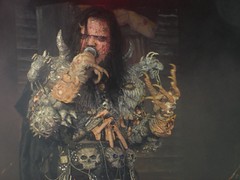
"This was worth living this far. I am so happy we are alive. Vodka!" (woman, late-20s, Finland)
"I am ashamed! I am sure they will drag some man from Lapland on stage and Marco B. will host it." (woman, early-30s, Finland, commenting on next year's ceremonies)
"Euphoria! National trauma has been overcome!" (man, mid.-20s, Finland)
"I have already fainted." (man, early 30s, Finland)
"Never been a democrat and proven 2 b right again." (man, late 20s, the Netherlands)
"Finnish popular culture goes Europe. Halleluja." (man, late 50s, the Netherlands)
"U need treatment... I always knew u Finns were a bit weird but this? Too much vodka in yr brains. And the worst thing is to see lobotomized Europe following u guys...It's a whole continent of zombies. Well, congratulations anyway, even though I would consider professional help ;)" (man, mid-30s, the Netherlands)
"Damn, it's your country. Almost forgot." (man, late 20s, the Netherlands)
"We had an afterparty until eight in the morning." (man, early 30s, Finland)