Tuesday, April 28, 2009
What Did You Do Daddy? from John Belflower on Vimeo.
I have been looking for a brilliant video blog and now I found it. Charlie and others have put together a great blog gathering Nubs. For those who don´t know what nubs are (me an hour ago), here´s the Make Nubs description: Nubs are short videos that explain or bring an idea to life. Check the blog for more, great stuff. For instance the Obama music video from MC Yogi is brilliant.
Sunday, April 26, 2009
Gem in Kamppi

I love these moments. When you think you know your city to the last stoney and then you bump into something quite amazing. It kind of feels embarrassing to make this discovery only now but better late than never: I visited Amos Anderson´s Art Museum for the first time in my life today.
I went in due to the Riiko Sakkinen and Jani Leinonen exhibition. I was not expecting much but wanted to base my opinion - some people would say for a change - on real experience. Well, I was not blown away. The exhibition kind of demonstrates how difficult it is to shock with anything anymore. I felt I had seen this stuff before.
But taking the lift upstairs to the 5th floor made my day. Amos Anderson has made a deal with a set of corporate collections and in this manner able to bring into daylight wonderful works of artists like Magnus Enckell and Helene Schjerfbeck, which normally only decorate a company office or are locked in a safe. Of course most of the exhibition was kind of boring for anyone who has visited Ateneum but in the middle of it all were the subtle and delicate portraits of Helene Schjerfbeck and the strikingly colourfully radical Enckells of boys on a beach. Amos Anderson deserves recognition for making these works available for us all. If you ask me, Enckell and Schjerfbeck are some of the best art this little country has to offer.
A great invention for Amos Anderson is also reserving the red brick attic for contemporary art. Maiju Salmenkivi´s Pasila painting is such an explosion of colour that it made me return for a second glance. Tiina Heiska´s somehow photographic bedroom scene painting is simultaneously sad and sensual. Amos Anderson´s Art Museum shows that next to publicly funded art, this country needs also philantrophists with taste.
Thursday, April 23, 2009
One Less Device in the World
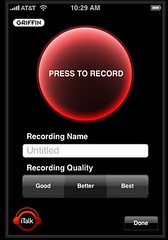
Tested it today and it works perfectly. Sound quality is good, it does not use a lot of battery and the files are easily transported to iTunes for further use. And what is most important, I did not need to buy more gadgets as Apple and its friends had solved the issue for me - free of charge.Thank you, Mr Jobs.
Wednesday, April 22, 2009
We Need A Project
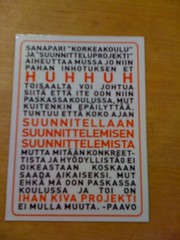
Quick translation:
"Coupling phrases ´higher education institution´ and ´design project´ causes such a bad disgust in me already that huh-huh (editorial note: Finnish expression for exhaustion). On one hand it may up to the fact that I am myself in such a shitty school but still it makes me doubt. It feels that all the time one designs the design of design but nothing concrete or useful is never achieved. But maybe I am in a shitty school and that one is a really nice project. That´s all from me. - Paavo"
However, looking at the issue from the positive side, it is a sign of healthy self-criticism that this quote is as a reminder in the coffee room.
Tuesday, April 21, 2009
Argumentti.com - concepts and arguments
One - not that serious - explanation to what I do for work. This time in the form of a video. More details shortly at www.argumentti.com. Thanks for the video tip, Paul.
Monday, April 20, 2009
Stranger´s Back
Fourth day in Amsterdam. If I would need to name one thing why this city if amazing, it is its Spring. The whole city is blossoming - something that we will get only in like a month in Finland. It is clear that it is still my Second City.
I just facilitated a a great two-day meeting with TheStrangers, the advisory group of StrangerFestival consisting of young video makers. Above one of them, Nerimon, talking about what we do. After this weekend I am quite convinced that the festival will be awesome this year. The deadline for entries is 15 August but this year it is wise to upload early as one video is picked every month as a monthly winner and the maker is invited to Amsterdam.
A bit more about Amsterdam. Cycling around this city, it is easy to understand why people love it so much. I do too. Amsterdam is the best city in terms of doing things in human scale. I wish more cities could give you this amazing feeling that the city is open for you, it is there for you and it is playful.
Thursday, April 16, 2009
Power of Both
This is where broadcasting meets the wonders of the Internet. Without this strong programme concept and reality television, Susan Boyle would never have emerged into the public sphere. The drama building before her singing is something that TV professionals can do so superbly. That´s talent.
But without the Internet and YouTube, Ashton Kutcher and Demi Moore would never have become fans of this English lady or she wouldn´t have become a world-wide phenomenon. Currently at 12 million hits. I love TV, I love YouTube and there´s no contradiction there. I think writing of television as a medium is just bull crap.
Wednesday, April 15, 2009
Made It To The Cover
Archis Foundation, Amsterdam
AMO, Rotterdam
C-LAB, Columbia University New York
First time I made it to a cover of a magazine. Here´s a teaser on the article:
"Several youth cultures show how difference can be a prerequisite rather than an obstacle to interaction. By giving serious attention to interaction practices in transnational youth cultures we could actually find answers to many of the diversity problems with which Europe currently struggles."
Volume can be bought from selected bookstores:
Amazon
NAI Publishers
Bruil
Archis
Monday, April 13, 2009
Real TV

Some people use Easter for quieting down - I did not. In the midst of Bree van de Kamp -like cooking and baking (muffins and what have you), I managed to accidentally bump into an episode of Skins on SubTV. I had forgotten how bloody brilliant this Channel4 teenage drama actually is. Thank you, Sub, for the reruns.
Skins is amazing and quite unique as its handles teenage angst and torment in full honesty and without irony. It reminds everyone what kind of an emotional rollercoaster it is being young and there is often very little the parents can do. It reminds one of the importance of handling the emotions of teenagers with care but also shows how smart they already are. Not a kid, not an adult - Skins captures well that tripping in and out of adulthood.
Here´s a clip (Channel4/YouTube apparently does not allow embedding)from this Friday´s episode where the class practices Osama - The Musical. It shows well how frank Skins is - maybe too frank for some. The writing of this programme is quite amazing. As it was pointed out to me while watching, could you think of a US series where teenagers sing:"Then came the day Osama blew us away and now I know how I feel."
Wednesday, April 08, 2009
Donate Here
Some advocacy organisations just get it better than others. WWF - the people who brought us Earth Hour. Via: Deceptive Cadence.
Tuesday, April 07, 2009
Institution First
I had yesterday lunch with a Danish friend of mine. She is one of those social entrepeneurs like me, i.e. people searching for new solutions to current problems. She said that her current interest is in using standard design techniques also for the planning of public services. This would mean bringing the problem and the end user into the core of the design process. As she pointed out, the common public service design process works like the YLE case: how do we fund an existing institution in the future.
When the design process starts from the institution, we are already kill a big majority of good ideas even before they see the light of day. When we take an institution and its current structure for granted, it is hardly surprising that we do not find very good solutions.
Everyone following media discussion today would know that public service communications needs rethinking. This is not an issue of organisational reform but an issue of citizenship - what kind of information and analysis do we need in order to play our role as citizens in a better and more informed manner? Getting stuck on the word broadcasting avoids looking into a landscape of new tasks, new actors and more flexibility. Now the fix is making a poorly functioning funding system compulsory. So it´s band aid instead of recovery process.
The private media corporations (Viestinnän keskusliitto) have been calling for Finland to follow the BBC Trust´s example in having an independent body supervising YLE. When the reform is prepared by a parliamentary committee, this is very unlikely to happen.
Although I am somewhat skeptical to the total agenda of the anti-YLE campaign of the private actors, I would strongly support an independent supervisory board. I believe it would strengthen YLE´s role as a supervisor of the ones in power, which would need to get its legitimacy not from decision makers but from people directly. It would make clearer that we as citizens have rights to proper critique and information and this might someone work against those in power. That sometimes the benefit of the state and the benefit of the people are not equal.
An independent body would also widen YLE´s stakeholder basis, help its directors in creative thinking and in the end - provide better public service media for us and help us in doing our share in a democracy better.
Monday, April 06, 2009
One More For The Road
Already on the flight to Kittilä, it was pointed out to me that the Finnair flight attendant allowed a Finnish man visibly drunk to occupy the seat in front of the emergency exit. I was informed by my company (someone who knows more about flying than anyone I have met) that this actually counts as a violation of airline protocol.
On the way back it got worse on the plane. The positive side was that we got to test the new Finnair Airbus 330-300, which will be used for flying to New York. It was the first week of the plane and things looked brilliant. The revamped Finnair colour scheme makes the cabin seem much more spacious and the new seats make you keep a good posture.
But as the plane was filled with Finns ending their one-week holiday either in Ylläs or Levi, it smelled like the empty bottle room of Alko. Big portion of the customers were visibly drunk already when boarding the plane. We actually changed our seats on the last minute due to the odour created by the people behind us. I managed to catch the frightened looked on a face of a young father who was forced to sit with his one-year-old in the middle of the Boozy Family. And the 5 euro charge for alcohol on domestic flights did not stop the people from boozing up more. I mean hey, last moment of holidays.
I am not blaming the cabin crew for slacking, I am sure they do not love the drunks in the back of the plane anymore than I do. After moving back to Finland from the Netherlands I have been in quite a number of situations where I notice how differently people and institutions tolerate overuse of alcohol in public transport, at stations not to mention restaurants. The Finnair case seems to be just another example of Finns looking the other way when the drunk is making another situation uncomfortable - or even risky as in the case of the emergency exit - for the rest of us.
Thursday, March 26, 2009
Once Were Consumers
The theme spreading across the book is the way we tackle climate change. According to Neuvonen and Mokka, most of us wish that there will be a day when we will be told by The Leader what not to do and until then most of us continue flying and buying in the current accelerating speed - fully aware of its consequences. The reaction is the same as a child who covers his eyes and ears to avoid the bad news. According to the book we need to recognise our role in change for as long as we wait for our elected leaders to make that switch, we are somewhat doomed. Over the last few years politics has actually taken its lessons from consumerism - politics is more a service industry answering people´s wishes than about ethics, ambitions or doing the right and responsible thing. This is very clear in political rhetorics of today. Therefore that SUV will only be banned when the big middle class takes another turn in its consumption. The book is a rare but realistic call for individual responsibility together with others.
The scenarios see control rising as we fight for limited resources. Control is also one of the ways to make people change. Rather than listening to our neighbours through the wall, in 15 years we can follow the ecological footprint of our neighbours from a public record Wastebook. In a world of less, we will surely make sure that our neighbours will not be free riding the system. This has been happening already in some countries in smaller scale for instance by people reporting their neighbours to the authorities when they do not recycle their trash.
The book claims that have moved from Social Democratic I Need Politics to more Centre Liberal I Want Politics. We are seeing the emergence of I Can Politics but the true change happens when we make a shift to We Can. When the media, corporations and governments take a bigger role in showing us the interconnectedness, we move from rights and responsibilities to virtues and pursuing truer happiness through responsible action and more meaningful human relationships. It moves discussion from what I want to what we can do.
This liberation from consumerism and move towards citizenship is quite inspiring and Case Obama is a good example of how it functions as a rhetorical tool. But I end up thinking, after reading the book, what happens when the resources really start running out. What are the arguments for building trust? The book paints a relatively beautiful picture of collective action but I feel it slightly - maybe for the argument´s sake - downplays the conflict and difference of opinion on the tools to make the switch. Politics is about deciding on those alternatives. It is not a question of The Good vs. The Bad but different strategies maybe even towards a shared goal. Does the urgency make our political system more responsible or more vicious What kind of leaders to we get, wish and deserve?
Olimme kuluttajia makes a convincing case that we have no alternative but to change. But I recognise I am already somewhat in the inner circle of this stuff. Reading it makes me reorient my professional focus to enhancing those positive developments and using my writing skills to formulate those attractive arguments to convince ever bigger parts of the population. This requires reaching over the aisle and bringing the engineer, marketeer and politician to the same table to build that map of interconnectedness. And yes, this is terribly exciting.
Monday, March 23, 2009
Who Wants To Be A Journalist
I have been mongering (is that a word) about the state of media education for ages. I feel that it more than often focuses on protecting young people from "the media", treats children and teenagers and imbeciles, forgets the role of amateurs in creating media content and forgets notions of critical reading. Good description of the current debate here. For all this, it was great to visit Piste and see that someone knows how to do it.
Sanoma Corporation has build a sort of a mini-Helsinki into the basement of its headquarters. The participants are divided to teams with some of them working for the quality daily Helsingin Sanomat and some for the tabloid Ilta-Sanomat. They all get mobiles, maps and guidance from an editor. All teams working on the same story and in the end they need to decide within their team on the angle of the story, on the headline and the photo.
Piste emphasises the key things in journalism:
- that good journalism requires dedication, persistence and investigation. You need to keep calling people, checking information given to you and making sure that you make good notes.
- it shows the essence of team work and clear division of tasks.
- it strengthens understanding that journalism is very much also about choices in terms of angle. That even if you have the same information, the story is different in Ilta-Sanomat and Helsingin Sanomat. Piste also demonstrates well how different the story seems with a different headline.
The great thing is also that the groups are led by real journalists who can through their own work show what all these issues mean in real life. I am sure this makes the visiting teenagers listen much more carefully. Our guide for instance was telling how you need to constantly make choices for instance around the school shootings on when to publish the name of the shooter or a certain photo. She also shed some light on the collaboration with the police and fire department.
I would be surprised if someone after Piste would not want to become a journalist. Piste demonstrates superbly how fascinating the job really is and how top quality media education really is done.
Friday, March 20, 2009
StrangerFestival Is About This
So, my former colleagues had put a clip from the StrangerFestival DVD online. I actually like how in this interview the background thinking of the project comes across.
And yes, someone should have told me to control those hands while I speak....I know, I know.
You can order your own copy of the DVD with this interview and much more from stranger (a) eurocult.org.
Wednesday, March 18, 2009
Nordic
I said first in the discussion that I would see the Nordic countries rather as a natural area of collaboration rather as an identity with historic routes. The ethnic-cultural-historical argument for the Nordic countries easily stands in the way of true equality and integration. The links are obvious to those Europeans who claim that we share the same values and a history.
I realised towards the end of the seminar that my idea of the Nordic region was something special and I feel parts of it can be explained through the Finnish language. I realise that I have grown up with an idea of the Nordic region as something where peace and justice prevail. This is something I picked up from school, not that much which country oppressed which Nordic country at which time and who really had the vikings.
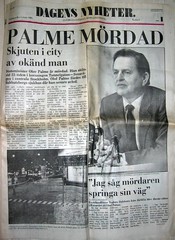
I was brought up with the idea that the Nordic identity and aspiration can be explained through actions of people like Anna Lindh, Olof Palme, Martti Ahtisaari or Hans Blix. That Finland was on its way to being Nordic. That Nordic means also peculiar people who do not fit to all conventions and who dare to touch our sensitivities like Tove Jansson, Lars von Trier or Ingmar Bergman. That Nobel Peace Prize illustrates Nordic actions by Nordic and non-Nordic people. That being Nordic means believing in the human being, having a clear sense of ethics, trusting your neighbours (passport-free border-crossing for ages) and working for the benefit of mankind. That here in the North we give from our own when we have enough. That Nordic is something we need to work for - hard. And more often than we would like to admit, we we fall short in living up to those noble ideals. That Nordic is not a state of being, it is a responsibility for action. And that of course we should not claim to own this package of ideals but that the combination of them makes our life up in these circumstances worthwhile.
I wonder if this articulation of the Nordic identity could also function as a tool for integration and inclusion. It may sound slightly naive but it gives me a sense of direction and a reason for optimism. In term of integration we wound need recognise those beautiful ideas, make concrete the individual and societal work needed to make our way towards them and be honest about the shortcomings in terms of greed, protectionism and selfishness. Of this we have a tremendous amount of examples from the last 20 years.
That we would consciously shift our focus to what we can become at our best and to our personal responsibility rather than obsessing over a shared past. The Nordic Dream seen here would be very different from the European or American one.
Monday, March 16, 2009
Public Service
Entertainment has been one of the issues on the battlefield - whether public service broadcasters should do entertainment or leave it to the commercial competitors. Watching Sweden´s SVT´s work on the Eurovision Song Contest (they call it Melody Festival) shows how an innovative public service broadcaster can turn European cooperation amongst public service broadcasters into a national megaprojects reinvigorating areas by taking the semifinals to different parts of the country. It is entertainment but entertainments with a special value. Corny, camp but brilliant. In Sweden the national finale is the main thing, not how the Swedish entry ranks in the European arena. I kind of like that.
Watching this programme and looking into the issue of commercial screens, I must conclude that I do support the idea of an independent expert body to control, set limits and open new areas for public service communications and press work. I feel this would make YLE stronger, release YLE from (unnecessary) parliamentary control and also serve the society and the license fee payers better. It might help us in really articulating in a clearer way what is actually the public service in public broadcasting. BBC says:Educate, Entertain and Inform - I would go more for something like Empower, Encourage and Represent (I wrote about this issue in this blog in September).
Thursday, March 12, 2009
Oops, Stockmann
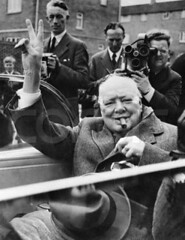
Or - as Toby well points out - that is what they were supposed to do. In the picture at Stockmann the hand is turned the other way than Churchill´s - i.e. in the picture the palm faces the person showing the sign -, which translates in the UK, Australia, New Zealand and a number of other places as Up Yours or F--- You. I am just waiting to see the confused English couple on a holiday in Helsinki standing in front of the display.
Oops. Well, it´s not like they would be selling S/M-themed puzzles in the toy section or something. Oh sorry, that happened already.


